August 20, 2026 · Trucko Team
Trucko.ai vs. Motive: Enforcement vs. Compliance-and-Safety Focus
Motive is built around compliance and safety. Trucko is built around enforcement. Here's how to decide which one your 5-50 truck fleet actually needs.
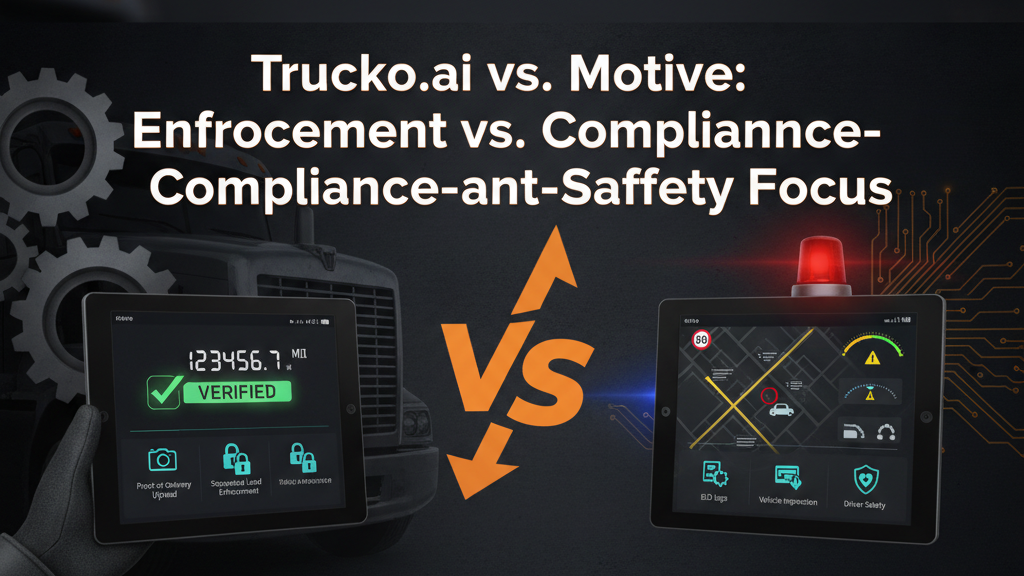
Trucko.ai vs. Motive: Enforcement vs. Compliance-and-Safety Focus
Motive is a real platform with real value. If you're running a fleet where FMCSA compliance, driver safety scoring, and ELD logs are your biggest operational headaches, it deserves serious consideration. But if your biggest headaches are mileage disputes, unpaid loads, drivers skipping steps at pickup, and nobody agreeing on what actually happened on a given run — Motive is solving a different problem than the one you have.
This comparison isn't about which platform is better in the abstract. It's about which one was built for your specific pain points.
What Motive Is Actually Built For
Motive started as an ELD compliance company and grew from there. Its core strengths are in driver safety, hours-of-service logging, dashcam footage, and compliance management. For a fleet that hauls regulated freight, has drivers under DOT scrutiny, or needs to defend itself in liability situations with video evidence, that's a meaningful stack.
The platform also includes GPS tracking, fuel card integration, and some dispatch tooling. It's built to give fleet managers visibility into where trucks are and whether drivers are behaving safely.
None of that is wrong. It's just aimed at a particular set of problems — regulatory risk, liability exposure, and safety culture.
What Trucko Is Actually Built For
Trucko is fleet accountability software built specifically around enforcement: gating what happens before, during, and after a load. The mechanism isn't tracking after the fact. It's requiring verified actions in sequence before a driver can proceed.
That means a driver can't mark a pickup complete without submitting odometer photos. Can't claim delivery without a timestamped POD capture. Can't start a new load while a previous one is still open. The record is built in real time, at each handoff, by the driver doing the work — not reconstructed later from GPS pings or self-reported numbers.
The cost that prevents: mileage padding on manual submissions, disputed deliveries with no documentation, and the hours a dispatcher burns chasing down paperwork after the fact.
According to a Chrome River study cited by Automotive Fleet, 76% of documented mileage fraud cases trace back to manual submission processes. That's not a driver character problem. It's a process problem — and it's the exact gap Trucko closes.
Where They Overlap (and Where They Don't)
Both platforms give dispatchers some visibility into what's happening in the field. Both have mobile apps for drivers. Both can surface documentation after the fact.
The difference is in what triggers that documentation.
With Motive, the system observes and records. Location data flows in. Safety events get flagged. A dispatcher can pull up a trip after the fact and see where the truck was. That's useful if you need to reconstruct a timeline or defend a liability claim.
With Trucko, the system gates and requires. A driver cannot complete a step without the corresponding verification. There's no reconstruction needed because the record was created at the moment of the action — by the driver, in the moment, before anything else happens.
That distinction matters most when your problem is internal: drivers and dispatchers disagreeing on what happened, loads going undocumented, mileage submissions nobody can verify.
If the dispute comes after the fact, tracking data helps you reconstruct. If you want to prevent the dispute from happening at all, you need enforcement at the point of action.
The Safety-vs.-Accountability Trade-off Is a Real One
Motive's dashcam and safety scoring features are genuinely useful for specific situations. If you have a driver who's been involved in incidents, or if you're managing liability exposure with an insurance carrier, video evidence and safety scores matter.
Trucko doesn't do dashcams. It doesn't score driver safety behavior on the road. That's not its lane.
What Trucko does is make every load handoff documentable and every mileage claim verifiable. If your current disputes are happening at the payment stage — not the insurance claim stage — that's the tool that addresses the actual problem.
Fleet managers running 5-50 trucks often deal with both kinds of problems. The practical question is which one is costing you more right now.
What "Compliance" Means for a Small Fleet
For a 25-truck fleet, compliance usually means two things: staying legal with the DOT and making sure loads are completed correctly and documented. Motive addresses the first definition. Trucko addresses the second.
The second definition doesn't get talked about as much in the industry, but it's where a lot of small fleet revenue quietly disappears. Freight that gets delivered but not properly documented. Mileage that gets padded because nobody can check the odometer remotely. Loads that overlap because a driver claimed completion before it was actually done.
None of that shows up in ELD logs. None of it gets caught by a dashcam. It requires a different enforcement layer — one that's designed around the workflow of a load, not the workflow of a compliance audit.
For a deeper look at how this kind of accountability differs from what GPS-based platforms offer, see GPS Tracking vs. Fleet Accountability Software.
Pricing and Fit for 5-50 Trucks
Motive's pricing is built around a platform that serves fleets of all sizes, including large enterprise operations. The feature set reflects that — it's broader than most small fleets need, which means you may end up paying for compliance tooling, safety analytics, and dashcam infrastructure that aren't relevant to your day-to-day problems.
Trucko is built specifically for the 5-50 truck range. The feature set is narrower by design: it does the enforcement and documentation work that matters for small fleet operations, without the overhead of tools aimed at regulated large-carrier compliance programs.
If you're comparing total cost of ownership, the relevant question isn't which platform has more features. It's which features map to the problems actually draining money from your operation.
For a similar comparison on the other major platform in this space, see Trucko.ai vs. Samsara: Which One Is Actually Built for a 5-50 Truck Fleet.
When Motive Makes More Sense
There are situations where Motive is the right call:
- You're running regulated freight under active DOT scrutiny and need airtight ELD records.
- You've had serious safety incidents and need dashcam footage to manage liability.
- Your insurance carrier requires specific compliance documentation.
- You're managing a large enough driver pool that safety scoring and coaching programs make operational sense.
None of those are small-fleet-specific problems, but they're real problems. If that's where your pain is, Motive is a serious tool for it.
When Trucko Makes More Sense
Trucko is the right call when the problem is internal documentation and enforcement:
- Drivers and dispatchers are regularly disputing mileage at pay time.
- Loads are getting delivered without consistent POD capture.
- You're losing time chasing paperwork after the fact instead of running loads.
- You're paying mileage on self-reported numbers with no way to verify them.
- Loads are overlapping because your current system has no lockout mechanism.
If any of those sound familiar, the tool you need isn't a compliance platform. It's an enforcement layer — one that requires verified actions in sequence and builds the documentation record at the moment it happens.
---
FAQ
Does Motive have any load-level documentation features? Motive includes some dispatch and driver workflow tools, but its core design is around safety, compliance, and tracking rather than gating load handoffs with verified documentation. It's not built to enforce sequential steps at pickup, delivery, and mileage capture the way Trucko is.
Can I run Trucko alongside Motive if I need both? Yes. Trucko handles load-level enforcement and documentation. If you have separate compliance obligations that require ELD management or dashcam footage, those are different tool categories and don't conflict. Some fleets use a compliance platform for regulatory requirements and a separate accountability layer for internal load documentation.
Does Trucko replace my TMS? No. Trucko is not a general transportation management system. It's accountability software focused on enforcing and documenting what happens at each step of a load. It works alongside dispatch and TMS tools rather than replacing them.
What happens when a driver disputes a mileage figure in Trucko? Because Trucko captures odometer photos at start and end of each run, the record exists at the time of submission rather than being reconstructed from memory or GPS estimates. That removes most of the ambiguity that drives disputes in the first place. If a dispute does come up, the timestamped photo record is the reference point.
Is Trucko suitable for a fleet smaller than 10 trucks? Yes. Trucko is built for the 5-50 truck range. A smaller fleet often feels the impact of mileage disputes and undocumented loads more acutely per truck, not less, because there's less margin to absorb the cost.
---
Ready to Stop the Guesswork?
Want to know how Trucko handles enforcement vs. compliance tooling for a small fleet? Check pricing and see it for yourself.
For reference, visit trucko.ai.
---